Optimizing SEO on Computer

5 Simple SEO Tips for Healthcare Businesses

Wondering why your healthcare business doesn’t rank all that well on Google? It’s because your website isn’t optimized for it!

SEO, or search engine optimization, has been a buzzword in the industry for years. But it’s important, and we’re going to show you how to do healthcare SEO yourself; simple, effective, and actionable tips.

Know Your Keywords

You own a healthcare business, so surely you already know what people are searching for, right? Unfortunately, many people get this step so wrong, and after doing all sorts of healthcare SEO, they still don’t get any more traffic!

To do this simply and effectively, come up with a list of services you offer. Then write down the benefits of these services. These are your keyword starters… but they won’t be what you optimize for.

Then, open up Google’s Keyword Planner and enter these phrases into the tool. You’ll be presented with a list of keywords, ordered by the amount of traffic available per month.

Look for long-tail keywords (keywords looking for something specific, usually more than 2 words in length) with significant volume, at least 200 monthly searches. Keep a list of these.

Get Your Meta Tags Straight

Those keywords you’ve come up with should be in your meta tags. You can see them between the head tags in the HTML of your site.

There are many types of metadata, but the two primary ones are the title tag and the meta description. The title tag should contain the topic of the page and should have your focus keyword for that page. The meta description should describe what’s on the page, in a sentence, containing the top few keywords you want for that page.

Focus On Your Local Area

Healthcare SEO is centered around local SEO. Local SEO focuses on people who are looking for a business in their local area, and is a goldmine for highly targeted traffic!

You need to create a Google My Business listing, if you are a local business with an address you want people to visit or a phone number you want people to call. Associate that My Business listing with your website and that business will pop up on Maps and in the main search results when people search for you (and sometimes when people search for your focus keywords!)

Post Excellent, Original Content

Google prioritizes good content over poorly-written or spun content, based on several complicated and secret factors. All in all, though, your content needs to provide great value to the reader, while also being original.

Remember that keyword planner tool we were talking about in the first step? Now we want to create content around these keywords. Choose a few of them and write articles about these topics, focusing on optimizing for a long tail. This is how you not only rank, but get quality traffic from Google!

Leverage Other Types of Media

It’s not just websites people search for. They’re also searching for images, videos, news, places, and more!

By making sure your images and videos have the appropriate keywords and metadata on them, you can help your website show up in search. People may click the video and image and go to your site from there, opening up an avenue for high-quality traffic!

young patient engagement

The Importance of a Strong Millennial and Young Patient Engagement Strategy

“Know your audience” is a central tenet of any communications strategy—and healthcare communications and IT are no exception. And that leads to two important questions all healthcare IT, marketers and communicators must ask themselves:

• How well do you really know your patients in the general age range of 18 to early 30s (interchangeably known as “Millennials” and “Generation Y”?

• How well does that knowledge influence your young patient engagement strategies?

The “Largest Projected Patient Population”

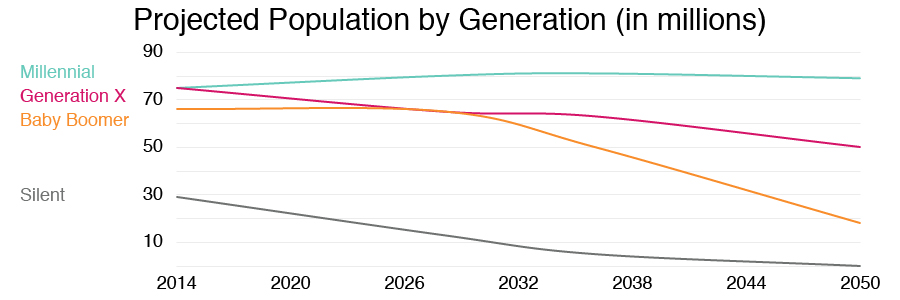
Perhaps a better descriptor for Millennials or Generation Y is “The Largest Projected Patient Population.” According to Pew Research Center data, Millennials—which Pew defines as “the population ages 18–34 as of 2015” that is now in the 21–37 range in 2018—already represent the largest generational population. But, as older generations age and their population sizes continue to decline, the Millennial population is projected to grow and remain steady until 2050.1 Population Chart

A Matter of Improving Young Patient Outcomes

Questions about “knowing your audience” are important because they put a spotlight on what is called generational marketing, which is a vital component of a healthy and comprehensive patient engagement strategy—and bottom line. For young patient engagement, this couldn’t be more true. As Patient Engagement IT perfectly said:
“Providers need to better understand the populations they serve and the threats to their business to remain competitive in their market and best manage their patients’ needs.”2
These questions are also about more than just ensuring your healthcare marketing strategy is hitting its most important demographic targets. Instead, it’s equally a matter of improving outcomes for young patients that are demonstrating a unique set of expectations, habits and tendencies for their healthcare. As Digital Journal explained:
“There is a concern among healthcare professionals that young people, particularly those with long-term health conditions, tend to disengage from health services. The outcome is a reduction in health outcomes.”3
If disengagement is a problem, then simple logic would dictate engagement is a solution. But is the solution simple to achieve?

The Millennial Patient Profile: Not What You May Have Expected

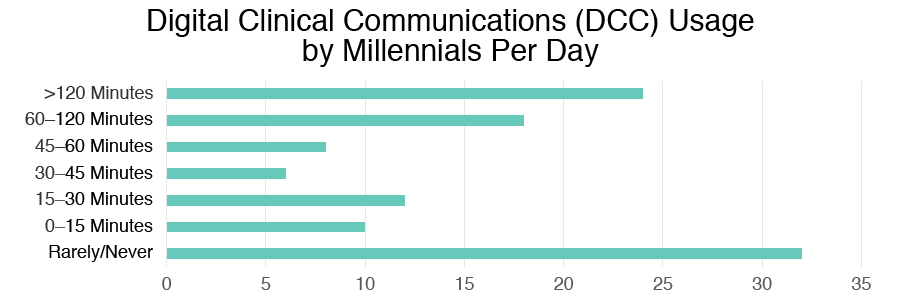
Things could be relatively simple if traditional or current patient engagement practices for older generations could be trusted for engaging with younger patients. The reality is the Millennial patient profile has some unique features that make it markedly different from other generations, which means they require their own sets of engagement practices. One valid assumption is that as a tech-savvy demographic, Millennials are reliant upon technology for healthcare purposes. This was verified in the Warwick University-led LYNC study, which looked at how digital technologies were used for clinical communications between health professionals and Millennials. It revealed patients used various “DCCs” (digital clinical communications like e-mail, text messages and VoIP) for a per-day median 45 minutes and a maximum of nine hours.4The Importance of a Strong Millennial and Young Patient Engagement StrategyBut there’s more to understanding the Millennial patient profile (and young patient engagement) than their lifelong exposure to the Internet and smartphones. Consider these facts HIMMS shared about Millennial patients:5

• 11 percent of are uninsured

• 17 percent do not think about cost when choosing a physician

• 41 percent reported they ask for estimates before receiving medical services

What emerges is a patient/customer profile (which HIMMS calls a “generational archetype”) that:

• Uses and appreciates technology

• Values health information and gets it from multiple sources

• Has or expects positive personal relationship with his/her physician

• Will find other caregivers after poor experiences

How to Use DCCs for Millennial Patient Engagement

A solid Millennial patient engagement plan needs to be more than just passively adopting and enabling digital clinical communication channels. Instead, research is showing that there are significant advantages for both patient and caregiver when DCCs are used with precision to enhance established connections. According to a Journal of Medical Internet Research article about the LYNC study:
“…findings suggest that benefit is most likely, and harms are mitigated, when digital communication is used with patients who already have a relationship of trust with the clinical team, and where there is identifiable need for patients to have flexible access, such as when transitioning between services, treatments, or lived context. Clinical teams need a proactive approach to ethics, governance, and patient safety.6
The JMIR identified the following DCCs and their best functionality in this regard: Telephone: Urgent communications Text messages: Appointment reminders for asking quick questions E-mail: More complex or lengthy information and links to resources However, for bad or upsetting news, JMIR said classic face-to-face interaction is the best communication method. So, with a better understand of how young people pursue their health care choices, how do you now feel about the two questions asked at the onset? If you are having any doubts about your Millennial patient engagement capabilities or strategy, now is the time to start evaluating and improving them.
Guideway Care is a cloud-based technology and services company that improves profitability and patient outcomes for hospitals and practices through end-to-end patient engagement solutions backed by clinical and non-clinical teams. Its HIPAA-compliant, SaaS platform improves care team workflows, automates patient communication and tracks patient progress to optimize the patient journey. Since 2004, leading healthcare providers have trusted Guideway Care to help acquire, manage and engage patients through complex episodes of care. 1 Generational Factors in Patient Engagement 2 Understanding Generational Differences in Patient Engagement 3 Digital Communication Helps Young Patient Engagement 4 Digital Clinical Communication (DCC) – Health Economic Findings of the LYNC study 5 Generational Factors in Patient Engagement 6 Timely Digital Patient-Clinician Communication in Specialist Clinical Services for Young People: A Mixed-Methods Study (The LYNC Study)
Best Healthcare Website

5 Ways to Get Your Own “Best Healthcare Website”

We are frequently approached by hospitals and clinics that want to know how they can have the “best healthcare Website” or how their Website currently compares on a national, regional or local level to top healthcare Websites. Although we can use tools that deliver quantifiable answers for the latter—including Google Analytics and Alexa—they aren’t as useful for answering the former. Do a Google search for “best healthcare Website” and you will see hundreds of results for blogs, awards and other pages. Although many provide solid references for what a “best healthcare Website” might look like, they usually don’t give you the guidance to get your Website into the same class. Having a slick-looking, modern Website is always nice, but there’s much more to having a top medical Website. For example, the ever-popular Mayo Clinic’s Website might be regularly rank high on many “best healthcare Website” lists, but it doesn’t mean your hospital or clinic should make a duplicate version. Instead, you need a Website that not only looks great, but is great because it performs and functions for specific reasons. Here’s an easy and remarkably practical method for getting your Website onto a path that will at least improve its appearance and performance—and perhaps someday land you on somebody’s “best healthcare Website” list. The process borrows from the “five W’s” problem-solving technique ideal for becoming more aware of your Website’s strengths and weaknesses.

Who is Your Audience?

Your immediate response might be, “Well, duh, our patients!” But seriously, think about it: How well do you understand the background of your audience—which, yes, are your patients? This includes a matrix of:

• Age

• Gender

• Culture

• Income

• Insurance and payment mixes

• Geography and proximity

• Medical priorities and needs

With those points, you should develop some abstract profiles of your audience. Now visit your Website and take an honest look at all  of it—photos, content, function, etc. How well does your Website look or feel relates to who your patients actually are or what they want from you? Takeaway: If your Website doesn’t reflect the makeup and needs of its audience, you will want to consider updating your content to be more representative.

What Does Your Website Need to Be or Do?

Now that you’ve thought about who your audience is, take it one step further: What do they need from it? This may include:

• Appointment scheduling

• Patient portals

• Physician and specialty searches

Or conversely, think about your Website and what your audience doesn’t need from it? This includes:

• Slow loading times

• Outdated or obsolete plugins

• Unresponsive design/no mobile version

Takeaway: If your Website’s technologies are not delivering the performance and convenience your patients expect, you’ll want to think upgrading or replacing your Website’s architecture or platform.

Where are Viewers Finding or Using Your Website?

If you regular follow this blog, you’ll already know the tremendous importance having a mobile-friendly healthcare Website. This is related to a simple fact: a majority of healthcare Website visitors visit on their mobile devices. Google’s recent mobile-first update (which uses the mobile version of a Website to determine keyword rankings for searches) has reinforced this concept and is already causing massive shifts in search engine result pages (SERPs). Takeaway: If you aren’t looking at your Website metrics at least once a month, you should immediately make it part of your routine. The more engaged you are with your metrics, the more inclined you’ll be to improve your Website. Even if you don’t have a strong healthcare SEO strategy, you still should be using Google Analytics to look at your healthcare Website metrics to learn as much as you can about your patient’s online visiting habits, routines and more.

Why Do You Have a Website?

This should actually be the first question in this list because it’s also the most important. Give it a moment and think: What’s the point of having a Website for your hospital or clinic? You will likely be flooded with numerous reasons why you have a Website, and most reasons will probably relate to the first question about “Who is your audience?” This is because the most important reason you have a Website is to improve patient experience—which in turn leads to more appointments, surgeries, etc., as well as better outcomes. It at that point you must ask yourself: If you can define crucial reasons for why you have a Website, what are you doing to ensure your Website fulfills those reasons? Takeaway: If your Website isn’t living up to its expectations, it’s time to revisit your marketing plan, pinpoint its objectives, and then start developing a strategy to improve your Website. You will likely discover you either have the internal resources or you don’t—in which case, you will want to find a proven medical Website design and development partner to help you in your quest towards having a “best healthcare Website”!
As Guideway Care Website development leader, Tonni Islam is one of our most reliable subject matter experts. Guideway Care is a cloud-based technology and services company that improves profitability and patient outcomes for hospitals and practices through end-to-end patient engagement solutions backed by clinical and non-clinical teams. Its HIPAA-compliant, SaaS platform improves care team workflows, automates patient communication and tracks patient progress to optimize the patient journey. Since 2004, leading healthcare providers have trusted Guideway Care  to help acquire, manage and engage patients through complex episodes of care.
Google First Mobile Indexing

It’s Not Too Late: Google Speed Test Your Healthcare Website NOW

Will You Be Ready for the “Google Speed Update” and Its Massive Impact on Your Healthcare SEO Rankings?

Google’s long-awaited mobile-first indexing finally began taking effect recently in full force, and we’re guessing you’ve seen the initial shockwaves for volatile healthcare keyword rankings. We hope you were well-prepared for it and am coming out unscatched.

Now the newest trepidation among my colleagues in the SEO blogosphere is with Google’s next anticipated SEO game-changer: the so-called “Google speed update.”

As with most big Google SEO shifts on the horizon, there’s always the “what we are certain about” and “what we think will happen.” For the Google speed update:

We are certain it will take effect in July 2018 and only impact some Websites.

We think it will soon after become a major ranking factor for all Websites (and will really hurt those that still haven’t recovered or adjusted from mobile-first indexing).

For those reasons, we’ve been updating our healthcare SEO clients’ websites programming based on the results of the Google mobile speed test to ensure their page speeds are up to spec.

It’s also why we’ve been receiving many questions about the Google speed update. Here are just a few!

What Exactly is the “Google Speed Update?”

Ever since 2010, desktop site speed has been what Google calls an important “signal” in its keyword ranking algorithm.1 The reason has always been simple: Google prioritizes positive user experiences, and faster sites contribute to that.

The upcoming “Google speed update” increases the importance of that signal—but puts the focus squarely mobile page speed.

Who Will the “Google Speed Update” Affect?

When the Google speed update was first mentioned on its Webmaster Central Blog2 in January 2018, they explained:

“The ‘Speed Update,’ as we’re calling it, will only affect pages that deliver the slowest experience to users and will only affect a small percentage of queries. It applies the same standard to all pages, regardless of the technology used to build the page. The intent of the search query is still a very strong signal, so a slow page may still rank highly if it has great, relevant content.”

Put another way: When the Google speed update rolls out in July and you notice some unusual drops in your rankings, you will probably want to first look at your mobile page speed. Chances are you have “pages that deliver the slowest experience” and Google is penalizing you for it.

How Do I Perform Google Speed Tests?

Google provides a free mobile speed and performance test that quickly gives you a comprehensive understanding of what you might expect from your mobile healthcare Website after the update is launched.

Just enter your Website address, and in about a minute, Google will tell you your:

• Loading time on a 3G network (and estimated visitor loss rates)

• Comparison to top-performing Websites in your industry (which should hopefully identify yours as “Health”)

It will also provide you with a free detailed report of fixes to speed up your mobile site.

Google also recommends some other tools that we also think are useful for improving your overall healthcare website performance. These include:

Chrome User Experience Report: Use this to get metrics for how real-world Chrome users experience your Website.

Lighthouse: An open-source, automated tool for improving the quality of your Web pages.

PageSpeed Insights: This analyzes the content of your Web pages and then generates suggestions to make that page faster.


We will continue to monitor this topic in the coming months!


As Guideway Care Director of Digital Marketing, Susan Gullion is one of our most knowledgeable resources for enhancing our healthcare clients’ search engine marketing strategies with SEO, PPC and social media.

Guideway Care is a cloud-based technology and services company that improves profitability and patient outcomes for hospitals and practices through end-to-end patient engagement solutions backed by clinical and non-clinical teams. Its HIPAA-compliant, SaaS platform improves care team workflows, automates patient communication and tracks patient progress to optimize the patient journey. Since 2004, leading healthcare providers have trusted Guideway Care to help acquire, manage and engage patients through complex episodes of care.

Using Site Speed in Web Search Ranking
Using Page Speed in Mobile Search Ranking


Bariatric Medical Practice Marketing Rule #2: Be Easy to Find! | Guideway Care - Sequence of Activation Blog

Bariatric Medical Practice Marketing Rule #2: Make It Easy for Patients to Find You

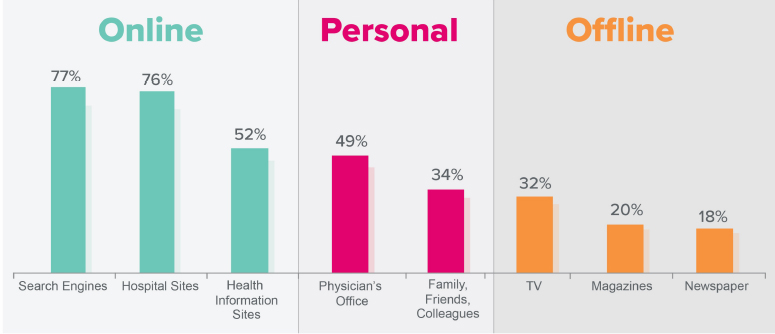
We kicked off this blog series with a discussion the first rule for growing your bariatric medical practice: the importance of “knowing your numbers.” This time, we will explore our next rule: make it easy for your patients to find you and begin their journey. Let’s begin with understanding how and where patients are finding healthcare services. It should come as no surprise that patients use online searches more than anything else—which includes personal referrals from physicians, family, friends and colleagues, as well as offline influencers like TV, magazines and newspapers.
Chart
Click to view larger.
We know this from a well-known Google study1 published this a few years ago that also showed how:

• More than 85% of patients began their searches online for health-related topics

• 48% of patients took more than two weeks to research before booking appointments

• 61% visited two or more hospitals sites before “converting” (more on this in a moment)

Find Yourself: Are You Experienced?

When we’ve asked bariatric healthcare marketers if they’ve ever tried to find their own hospital or clinic online—the same experience a potential patient would have—the answer is often no. We are driving home an important point, not pointing fingers: If it’s not easy to find yourself online, imagine what it must be like for patients that aren’t even aware of you, especially in competitive markets! With so much at stake with patients being able to find your bariatric medical practice online, the importance of online search strategies, healthcare advertising and tools become increasingly obvious—and even more when you learn that:

• Searches drive nearly three times as many visitors to hospital sites compared to non-search visitors

• Organic search results are more than 80% more likely to be clicked on than paid search results

The ABCs of Bariatric Marketing with SEO, SEM and PPC

Great SEO (search engine optimization) is the key to getting your share of organic search traffic to your bariatric surgery center’s Website, but it can take time to develop a solid SEO strategy and to see the results. That’s why we should not be too quick to downplay healthcare digital marketing and the amazing potential of paid searches, also known as PPC (pay-per-click) and SEM (search engine marketing). With the right combination of creatives (ads), keyword selection and bidding, patients will take action. According to Google, it’s meant:

• 28% visiting the advertised hospital’s Website

• 21% considering the advertised hospital

• 5% contacting the advertised hospital

Conversions: Are You Turning Prospects Into Bariatric Surgery Patients?

No matter how much search traffic comes to your bariatric hospital’s Website, it doesn’t mean anything unless you have great “conversion rates,” another way to say: Are you turning prospects into patients after they’ve found you? This leads to two immediate questions:

• What is your current conversion rate?

• How can you increase your conversion rate?

If you are finding that your conversion rates aren’t meeting your expectations, you will want to again return to the earlier question about trying to experience what it’s like to search for your facility. This time, try to understand the experience of your Website. How would you answer the following questions:

• Is your Website appealing to prospective patients?

• Is your Website optimized for both mobile and desktop?

• Is it easy for patients to find the right information?

• Is there a clear call-to-action (CTA) on the Website to help patients get started?

• Do you offer seminars—and if so, what type and how often?

Don’t assume low conversion rates are entirely the fault of the Website, though. This is especially true if you are noticing a sharp decrease in rates between Website registrations and seminar completion. In this case, consider these enhancements:

• Automated reminders prior to seminar

• Personal phone call prior to seminar

• Offer more seminar times or online options like Webinars

We’ll close on that note, but when we resume, we’ll talk more about increasing intake rates after seminars and Webinars.
As Guideway Care Central/Western Regional Director, Chris Stearns regularly engages with bariatric medical practices to find solutions that help grow their revenues and profitability. Guideway Care is a cloud-based technology and services company that improves profitability and patient outcomes for hospitals and practices through end-to-end patient engagement solutions backed by clinical and non-clinical teams. Its HIPAA-compliant, SaaS platform improves care team workflows, automates patient communication and tracks patient progress to optimize the patient journey. Since 2004, leading healthcare providers have trusted Guideway Care to help acquire, manage and engage patients through complex episodes of care. 1 The Digital Journey to Wellness: Hospital Selection
Google First Mobile Indexing

Got HTTPS? Big Chrome 68 Web Security Changes are Coming

You’ve Got Until Summer to Update Your Hospital Website Security and Avoid Being Marked as “Not Secure”

For more than a year, we’ve been closely watching Google for updates about their ongoing push for Websites to adopt HTTPS encryption (which is sometimes also called TLS/SSL encryption). Last week, we finally heard the game-changing news we’ve been waiting to hear since 2016:
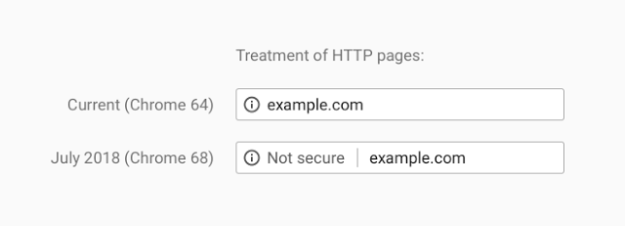
“Beginning in July 2018 with the release of Chrome 68, Chrome will mark all HTTP sites as ‘not secure.’” 1
Chrome's HTTP Page Labels
An example of how Chrome 68 will mark unsecure Websites.
The key word is all, and that’s because Google has been gradually phasing-in Web security requirements for certain kinds of Web pages. That will all change in July 2018, which is why it’s no longer just a good idea to update your practice or hospital Website security, but now a very, very, very strong recommendation to do so.

Don’t be Confused, We’ve Got You Covered

In case you don’t fully understand what any of this means—or its implications for your healthcare Website—don’t worry. As mentioned, we’ve been watching this closely, and we’ve said plenty about it our blog. We first suggest you visit Is Your Hospital Website Secure Enough for Google in 2017?, which we published in late 2016. In it, we addressed the basics of healthcare Web security, including:

• How to determine your Web security status

• How to update your Website security

We next encourage you to visit another piece we published last fall, Will Chrome 62 TLS/SSL Requirements Affect Your Users’ Experiences or Your Online Rankings?. This time, we addressed Chrome 62’s labeling of certain pages that weren’t secured and explained its:

• Potential impact to your SEO and SERPs (search engine result pages)

• Likely impact to your hospital Website conversions and patient conversion rates

• Possible impact to patient confidence in your brand

2018: The Year of Google Disruption?

Those that celebrate Chinese New Year know that 2018 is the “Year of the Dog.” Because the Guideway Care SEO team so closely follows Google, we’ve become inclined to say 2018 might also be called the “Year of Google Disruption.” We have a feeling this year will be a big year of changes on the Internet as it relates to Google. We’ve already seen a lot of disruption in keywords rankings in January 2018. We also know Google has been threatening to change to mobile-first indexing (from desktop-first) for more than a year, which will not bode well for Websites that are not responsive or don’t have a mobile version of their Website (and which we’ve also discussed in our blogs). For the moment, we can be 100-percent certain about Chrome 68’s impacts on Website security—although the question now is knowing exactly which day in July 2018 it will get launched!
As Guideway Care  Associate Director of Search Engine Marketing, Susan Gullion is one of our most knowledgeable resources for enhancing our healthcare clients’ search engine marketing strategies with SEO, PPC and social media. Guideway Care is a cloud-based technology and services company that improves profitability and patient outcomes for hospitals and practices through end-to-end patient engagement solutions backed by clinical and non-clinical teams. Its HIPAA-compliant, SaaS platform improves care team workflows, automates patient communication and tracks patient progress to optimize the patient journey. Since 2004, leading healthcare providers have trusted Guideway Care  to help acquire, manage and engage patients through complex episodes of care. 1A Secure Web is Here to Stay
Discussion on How to Grow Your Bariatric Practice

Bariatric Medical Practice Marketing Rules #1: Know Your Numbers

The First of a Four-Part Series of Advice for How to Grow Your Bariatric Practice

We regularly speak to many bariatric programs across the country, and we often hear how difficult it is to manage the day-to-day operations while keeping up with the hundreds of patients that are on their journey to bariatric surgery. Yet, no matter how many patients they have, nearly all want or need to increase their bariatric patient volumes. That is why we are frequently asked a simple but important question: “How can I get more patients and grow my bariatric practice?” Although there are no simple answers, we have been able to boil them down into four key rules that we explore in one of our most popular presentations, Four Key Strategies to Grow Your Bariatric Program. Which leads to the first rule: Know your numbers. Here is what we mean by that.

What are Your Numbers? Where are They?

Bariatric practice marketing is a numbers game you can play best if you have a firm grasp on your data. Otherwise, it is virtually impossible to develop strategies and gauge their effectiveness if you don’t know where you stand. Let’s start with some basics like:

• What are your conversion rates from lead to surgery?

• What is your average time to surgery?

• Which steps in the prospect-to-patient continuum are taking the longest?

• Where are patients falling through the cracks?

Now ask yourself:

• How quickly could you produce those numbers for analysis?

• How simple would the process for accessing them be?

• How reliable would the data you retrieved be?

The last set of questions can be as telling as the first set. We’ve found the bariatric practices that can easily and accurately track their patient marketing, acquisition, management and engagement are almost always the most successful practices.

Learn From Your Numbers

Knowing about your bariatric practice’s numbers is only the beginning. Once you’ve established an efficient process for monitoring your bariatric marketing efforts and collecting data, you next want analyze your numbers and starting learning from them. And what better way to learn is there than to ask questions? Here is where we divide our focus into two primary areas, each with their own sets of unique questions. For how many of these can you produce answers? Do any spark insights into where your bariatric practice marketing is underperforming? Bariatric Marketing and Patient Acquisition

• What is the conversion path of our marketing efforts?

• How many conversions resulted from the campaign?

• What is my cost per lead?

• How many surgeries resulted from the campaign?

• What is my cost per surgery?

• What payor mix is my marketing campaign driving?

• What is my most effective marketing medium?

• What is my least effective marketing medium?

• Of the surgeries we’ve performed, where did those leads come from?

Bariatric Patient Engagement and Management

• What is my conversion rate from lead to seminar registration:

• …from seminar registration to attendance?

• …from seminar attendance to consult?

• …from consult to surgery?

• What is my overall conversion rate from lead to surgery?

• What is the average throughput for each of these milestones?

• Where are patients falling through the cracks?

• How long have patients been in each step?

• What clearances need to be completed in order to have surgery?


As Guideway Care Central/Western Regional Director, Chris Stearns regularly engages with bariatric medical practices to find solutions that help grow their revenues and profitability. Guideway Care is a cloud-based technology and services company that improves profitability and patient outcomes for hospitals and practices through end-to-end patient engagement solutions backed by clinical and non-clinical teams. Its HIPAA-compliant, SaaS platform improves care team workflows, automates patient communication and tracks patient progress to optimize the patient journey. Since 2004, leading healthcare providers have trusted Guideway Care to help acquire, manage and engage patients through complex episodes of care.
Google First Mobile Indexing

Five Key Mobile Website Design Tips for Hospitals and Clinics

Now is the Perfect Time to Get Ready for Google Mobile-First Indexing

Late last year, we talked about the importance for healthcare Websites to be ready for Google mobile-first indexing to roll out in 2018, which can happen any day now! If you haven’t already, now is the perfect time to review some mobile Website design tips that can help your hospital or clinic improve the quality of your mobile users’ experience, which in turn should lead to improved search engine rankings and more conversions.

Analyze and Test Your Website

Google Mobile-First IndexingBefore you can improve your healthcare mobile Website design, you need to be positive it is ready for mobile-first indexing, which we discussed in “Google Mobile-First Indexing: Is Your Healthcare or Hospital Website Ready? Once you’ve confirmed you are ready, the next step is to analyze its performance with Google Analytics. (If you’ve had to make some significant changes to get ready, allow a couple of weeks for new data to accumulate). Are there any pages that have unusually low traffic volumes? Or are there any calls to action that are demonstrating unusually high bounce rates? Looking at these types of metrics can quickly let you know the areas in which you’ll first want to improve.

Provide a Link to the Desktop Version

Always let your mobile visitors have the option to link to a complete desktop version of your healthcare Website. This may seem to contradict the whole purpose of having an optimized mobile Website, but some visitors may prefer to browse your desktop version on their mobile devices.

Use Simple Menus

Whether you choose to use collapsable “hamburger” menus, the most important mobile website design tip for menus (and submenus) is to keep them as simple as possible. Links to downloadable clinical trial report PDFs are an perfect example of what to prune from your menus. Healthcare mobile users are not likely to download or read such documents on their phones. If you must provide these types of links, consider asking users for their e-mail addresses so a link can be sent to them for downloading later.

Make Searches Fast and Intuitive

Mobile users heavily rely upon in-site searches, especially since menus are not as easy to navigate as they are on desktops—no matter how much you’ve simplified them for your mobile Website. Here are three key mobile Website design tips for making searches fast and intuitive:

Don’t bury your search in a menu. Experiment with different types of searches that can can be initiated and completed without going into a menu. Explicit (visible) search bars are one of the best ways to start experimenting with what will work best for you, as are filters and questions to guide search queries.

Optimize search result relevance. The better your search tools can provide relevant results, the faster users can find what they need.

Make search results easy to view. Always remember your users are not on larger desktop screens, and therefore, it’s crucial they can quickly understand and navigate search results.

Be Selective with Calls to Action and Forms

This final healthcare Website design tip continues the theme for speed and simplicity, especially if your hospital or clinic heavily depends on your Website for patient acquisition. On your desktop Website, you have the luxury of asking prospects for information well beyond their names and contact information. But for mobile users, every extra field they’ll need to complete (even if optional) can make a form seem long and difficult to complete. If you find it difficult to reduce the scale of your conversion tools, consider running A/B tests with Google Analytics. Set your test to randomly display a shorter or longer version of a form and then measure their performance.
Tonni Islam is a Senior Designer at Guideway Care. Guideway Care is a cloud-based technology and services company that improves profitability and patient outcomes for hospitals and practices through end-to-end patient engagement solutions backed by clinical and non-clinical teams. Its HIPAA-compliant, SaaS platform improves care team workflows, automates patient communication and tracks patient progress to optimize the patient journey. Since 2004, leading healthcare providers have trusted Guideway Care to help acquire, manage and engage patients through complex episodes of care.
HIPAA Compliant Texting

HIPAA Compliant Texting: Are You Doing It Right?

Simple Ways to Ensure Your Hospital or Clinic’s SMS Text Messages are Satisfying HIPAA and PHI Compliance

Most healthcare providers are aware that the best intentions can occasionally result in disaster. Sending SMS text messages—with colleagues or patients—is a prime example. Did you know that violating rules for HIPAA compliant texting can result in fines of $50,000 to $1.5 million per occurrence? Yes, that’s per occurrence. And think about it: How easy is it have multiple SMS conversations that include multiple text messages? How can you take advantage of using text messaging to provide better healthcare but still be HIPAA compliant? Here are some guidelines.

No Texting Means No PHI or HIPAA Violations

The easiest way to ensure you are sending HIPAA compliant text messages is to just not send non-personal text messages to patients or colleagues. More specifically, that means refrain from sending anything that would be considered protected health information (PHI) by the Health Insurance Portability and Accountability Act (HIPAA). HIPAA’s complete list of what makes something PHI is lengthy, but the general idea is it includes any written or visual information an unauthorized third-party could use to identify a patient, including:

• Names (including family members)

• Addresses

• Dates

• Phone and fax numbers

• E-mail addresses

• Website and IP addresses

• Social Security numbers

• Medical record numbers

• Photographs

• Biometrics (such as fingerprints)

Not accepting or discouraging text messages from patients is another way to ensure HIPAA compliance. This guidance may be overstating the obvious, but the reality is our mobile phones have become such common and convenient parts of our personal and professional lives, it’s tempting to use them. That desire might be even greater at smaller clinics where staff and patients may feel more comfortable exchanging their mobile phone numbers.

Use HIPAA-Compliant Communication Platforms for Texts…and e-Mail, too

If your hospital or clinic is compelled to use text messaging to improve patient engagement and outcomes—either to communicate with patients or for staff to communicate internally—it’s crucial that you are using a secure, HIPAA-compliant text message platforms and servers from providers. The same rules and penalties for HIPAA compliant texting apply for e-mail too, which is another convenient way to communicate with smartphones. Your hospital or clinic can take advantage of using e-mail to engage with patients if you are using secure, HIPAA-compliant technologies and protocols.
As Guideway Care Central/Western Regional Director, Chris Stearns is one of our key healthcare IT experts. Guideway Care is a cloud-based technology and services company that improves profitability and patient outcomes for hospitals and practices through end-to-end patient engagement solutions backed by clinical and non-clinical teams. Its HIPAA-compliant, SaaS platform improves care team workflows, automates patient communication and tracks patient progress to optimize the patient journey. Since 2004, leading healthcare providers have trusted Guideway Care to help acquire, manage and engage patients through complex episodes of care. HIPAA Compliant Texting
Google First Mobile Indexing

Google Mobile-First Indexing: Is Your Healthcare or Hospital Website Ready?

Google Mobile-First Indexing
The Long-Awaited Change in How Google Will Rank Healthcare and Hospital Websites is Just About Here

Since 2016, my colleagues in the SEO blogosphere have been regularly waxing about the importance of being prepared for Google to roll out its “mobile-first indexing.” Although it hasn’t yet to be launched, it is coming—and when it does, it is expected to have significant impacts on how healthcare and hospital Websites are ranked.

In recent months, several of our healthcare SEOand hospital Website design customers have asked us about mobile-first indexing. Here are some of their most frequently asked questions. As you read on, ask yourself: Is your hospital’s Website and SEO ready?

What is Google Mobile-First Indexing?

Google’s mobile-first indexing is the search engine’s conversion to using a mobile Website (rather than its desktop version) for ranking Web pages.

As to whythey are doing this, Google offered this explanation on its Official google Webmaster Central Blog:

“Today, most people are searching on Google using a mobile device. However, our ranking systems still typically look at the desktop version of a page’s content to evaluate its relevance to the user. This can cause issues when the mobile page has less content than the desktop page because our algorithms are not evaluating the actual page that is seen by a mobile searcher.”

How Will Mobile-First Indexing Affect My Healthcare SEO?

If your mobile Website provides the same information as your desktop Website, you probably won’t notice any difference in your SEO rankings. Actually, you might even see a boost in your rankings if you are competing against hospitals whose Websites are not ready for mobile-first indexing.

You might now be thinking, “What do you mean by ‘the same information?’” Why would it be different on a desktop or mobile Website?

The short answer is: It mostly depends on how your desktop and mobile Websites were design. This means:

If you have a newer Website that was built with responsive design — meaning the site automatically adjusts its layout based on whether your visitors are using desktop or mobile browsers — you probably don’t need to worry.

If your Website isn’t “responsive” but sends the same layout no matter the browser, you also probably don’t need to worry. (Note: Because responsive Websites generally deliver better user experiences, comparable Websites with responsive design will likely have better rankings.)

If your Website uses different URLs for canonical and mobile browsers, you might not be sending the same information. This could range from minor inconsistencies between what is on the desktop and mobile pages to significantly abridged content on a mobile page.

If your mobile Website uses AMP (Accelerated Mobile Pages), you might not be sending the same information. A typical example of different information would be when an AMP shows a snippet of a desktop page with a link to read it in its entirety. These types of AMPs will hurt your SEO because it’s not supporting what Google considers to be a positive user experience.

If your Website is not ready for mobile-first indexing, it’s probably best to update or overhaul your Website to a responsive design. But, if budgetary or time constraints prohibit that, your best bet is to prioritize the Web pages that can’t afford to be dinged by mobile-first indexing and start analyzing/updating them.

When Does My Hospital Website Need to be Ready for Mobile-First Indexing?

For all the chatter there’s been the past year about mobile-first indexing and the need to be ready for it, there’s still no set date for when Google will enact it. There is a good possibility that Google has been testing this new indexing strategy over the past year and we won’t see an exact date for its final roll-out. Our recommendation is to be proactive now before you see a drop in visitors to your Website.


As Guideway Care Associate Director of Search Engine Marketing, Susan Gullion is one of our most knowledgeable resources for enhancing our healthcare clients’ search engine marketing strategies with SEO, PPC and social media.

Guideway Care is a cloud-based technology and services company that improves profitability and patient outcomes for hospitals and practices through end-to-end patient engagement solutions backed by clinical and non-clinical teams. Its HIPAA-compliant, SaaS platform improves care team workflows, automates patient communication and tracks patient progress to optimize the patient journey. Since 2004, leading healthcare providers have trusted Guideway Care to help acquire, manage and engage patients through complex episodes of care.